











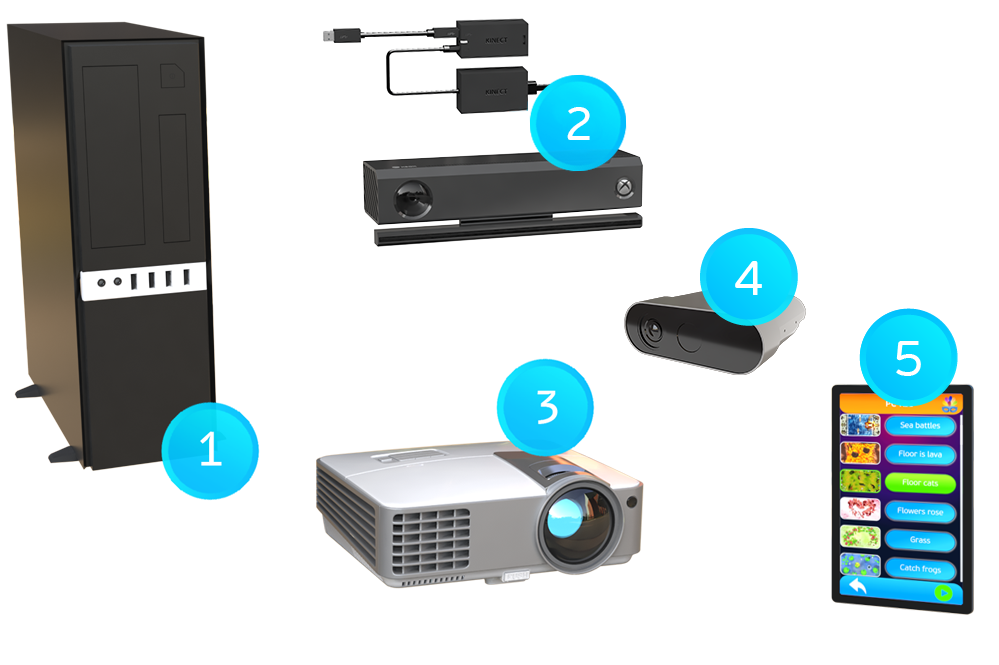


Interactive Immersive Projection Walls — Motion-Responsive Visual Experiences
A practical guide to what interactive immersive walls are, where they are used, how projection and motion-tracking hardware are installed, who benefits, what problems the technology solves, how people control the system with body movement, what kinds of visuals are effective, and how operators monetize installations in public spaces and family entertainment venues.
What is immersive interactivity?
Immersive interactivity refers to systems that surround visitors with large-scale digital visuals that respond directly to their movement. Unlike small touchscreen interfaces, immersive projection walls create an environment where motion—hand gestures, body position, and walking—becomes the primary controller. These systems combine high-resolution projectors, motion-tracking cameras, and software that maps movement to dynamic visual behaviors. The result is a tactile, intuitive, and engaging experience that invites exploration, play and relaxation.
Where are immersive projection walls used?
Immersive projection walls are used across many contexts:
- Museums and exhibitions: as interactive art pieces or story-driven displays that react to visitors.
- Children’s museums and family entertainment centers: safe, hands-free play areas with high replay value.
- Public spaces and retail: to attract visitors, create photo opportunities, and increase dwell time.
- Wellness and sensory rooms: calming visual environments for relaxation and therapeutic use.
- Educational environments: to present content in an exploratory, kinesthetic way.
How to install a projector and motion-tracking camera
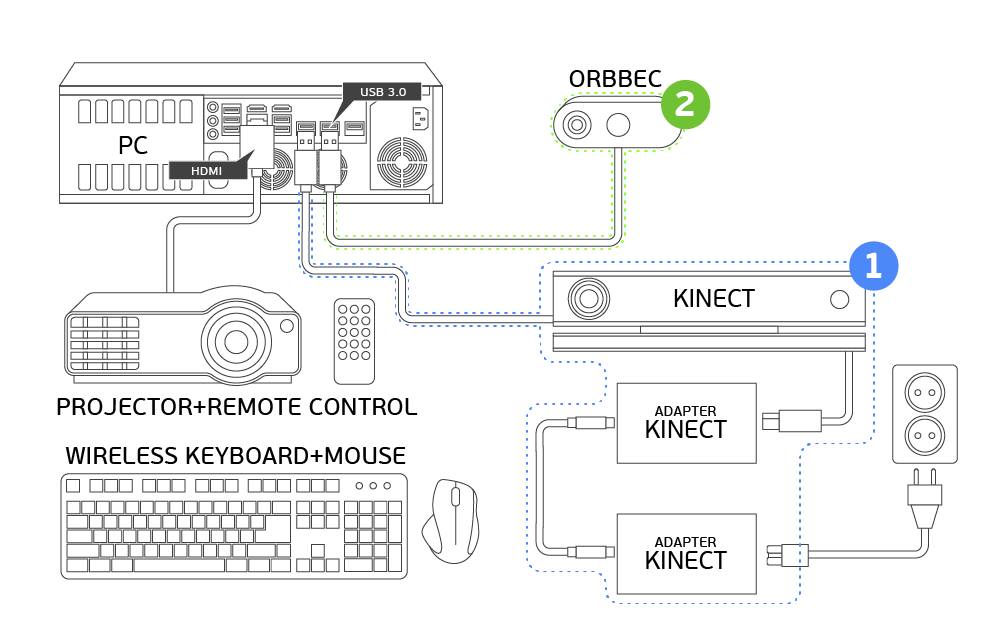
Installation follows three main pillars: projection, tracking, and software integration.
Projector placement
Projectors are mounted either on the ceiling or opposite the projection surface. Key considerations include throw distance (to achieve the required image size), lumen output (to ensure visibility in ambient light), and lens type for edge clarity. Projectors should be securely mounted, protected from accidental impact, and placed so that maintenance access is straightforward. Calibration is required to align the projected image precisely with the interactive zone.
Motion-tracking camera setup
Motion cameras—typically depth sensors, 3D cameras, or infrared (IR) tracking systems—are installed to cover the interaction volume. They should have an unobstructed view of the space and be mounted with a stable field-of-view to reduce jitter. Important steps include configuring the capture volume, tuning sensitivity to detect hands and bodies reliably, and calibrating the sensor to the projected coordinate system so tracked points match visual elements.
Software and calibration
Software maps tracked coordinates to the rendered scene. Calibration aligns camera coordinates with projector pixels (camera-projector registration). The software also filters sensor noise, interprets gestures (speed, direction, acceleration), and routes input to the visual engine. Robust error-handling—to manage occlusions, multiple users, and lighting changes—is critical.
Who is it for?
Immersive walls are designed for a wide range of stakeholders: children (play and development), families (shared entertainment), museums (visitor engagement), brands (experiential marketing), property managers (enhanced public space utility), and therapists (sensory stimulation). For operators, the technology can function as a signature attraction, a community amenity, or an income-generating installation.
Problems this technology solves
Interactive projection walls address several practical needs:
- Visitor engagement: create memorable, participatory experiences that increase satisfaction and retention.
- Traffic and dwell time: attract and retain visitors in public and retail areas.
- Inclusive interaction: enable touch-free engagement suitable for young children and accessible to people with different abilities.
- Atmosphere and wellbeing: calming visuals can support relaxation zones and therapeutic environments.
How people control the experience
Control is intentionally intuitive and body-driven. Common control mappings include:
- Speed: faster gestures increase animation velocity, particle dispersion, or color saturation.
- Direction: the vector of movement redirects particle flows, waves or streaks.
- Proximity: moving closer can intensify an effect or cause elements to contract/expand.
- Multi-user interaction: overlapping inputs create compound reactions—blends, collisions, and shared visual outcomes.
Systems should provide visual affordances and gentle feedback so users understand cause and effect without instruction.
What visuals work best
Most effective visuals for immersive walls are abstract, colorful, and motion-driven. Examples include:
- Amorphous light clouds that shift with motion.
- Particle fields that scatter or gather based on gesture energy.
- Flowing gradients and waves that follow hand vectors.
- Paint-like splashes and droplets that respond to taps and sweeps.
Key design goals are contrast, fluidity, and responsiveness—visuals should look rewarding to manipulate and clearly reflect the visitor’s input in speed and direction.
Monetization in public spaces and family entertainment venues
Operators can monetize immersive projection walls through multiple strategies:
- Direct revenue: timed-entry tickets, pay-per-play, or premium themed sessions.
- Ancillary spend: photo packages, branded merchandise, and concessions that capitalize on increased dwell time.
- Sponsored content: brand partnerships, sponsored overlays, or co-branded experiences.
- Venue enhancement: higher footfall and longer visits increase overall revenue for retail partners or landlords.
Conclusion
Interactive immersive projection walls are a versatile, high-impact medium for engagement. They translate human movement into visually rewarding responses—typically bright, colorful, abstract animations that react to speed and direction. Used in museums, public spaces, wellness rooms, and family entertainment parks, these installations create memorable shared moments and offer flexible monetization opportunities for operators. Thoughtful hardware placement, reliable motion tracking, and carefully tuned visuals are the foundation of a successful deployment.